
On this page
It’s jump rope. Then the cards cheat.
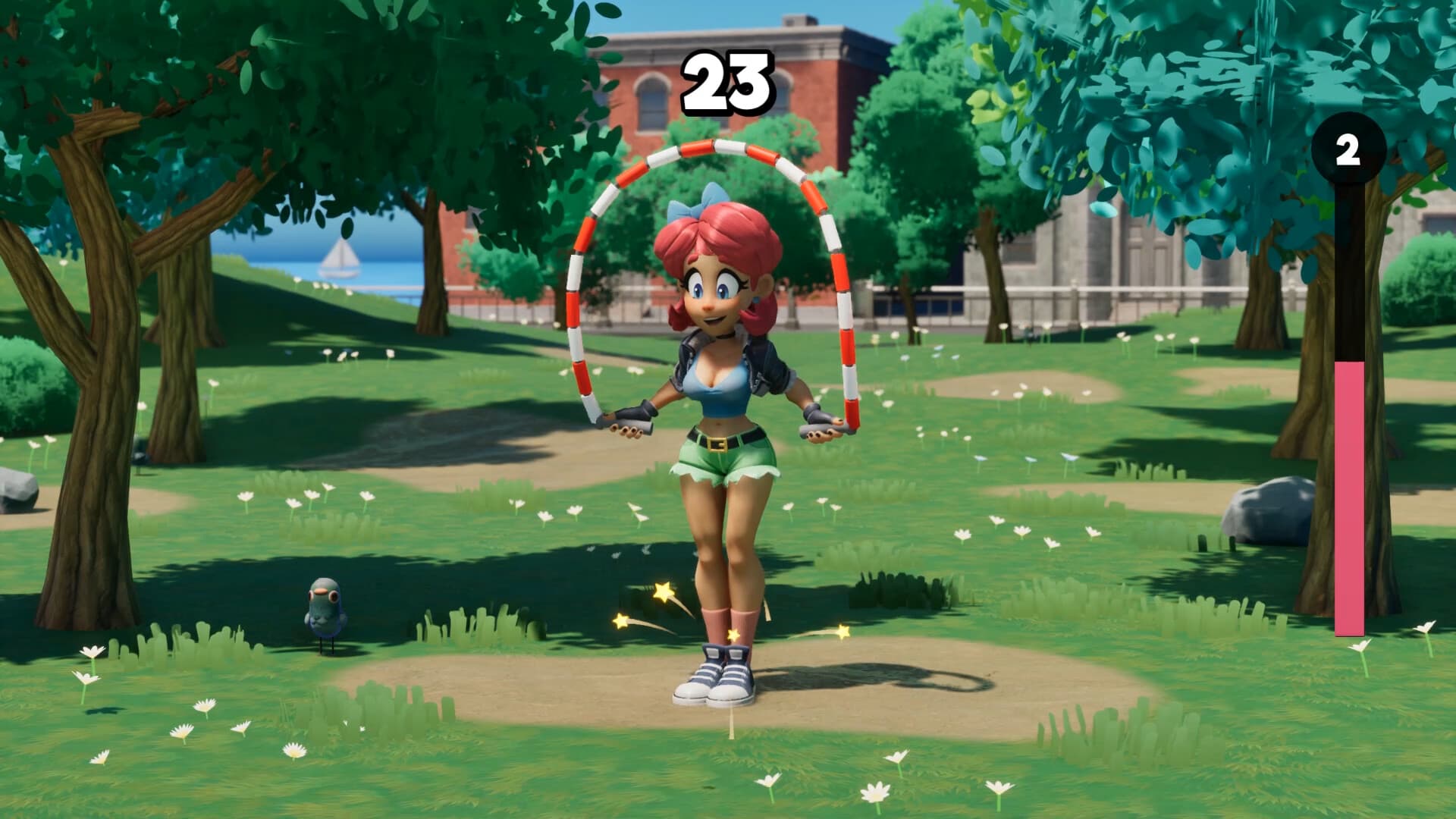
Scarlet Skips is a one-button jump-rope game from Yerk Games. Press, hold and release to control Scarlet. At a level-up, choose one of three cards and adjust to what it changes.
More height shifts the landing. Faster or extra ropes change the timing. Later, Rocket Shoes can extend a jump for a score route.
- Steam, Windows, September 3, 2026.
- 10 cards. 3 random choices each level.
- One Steam achievement. Cards stack.
One button: press, hold, let go
There’s one input: press, hold, release. Press just before the rope reaches her feet. Hold only as long as needed, then release with the next pass in mind.
Watch where the rope meets the ground, not Scarlet’s hair. That crossing is easier to time repeatedly.
- Let the rope make one full turn before you rush the first jump.
- Start with short, repeatable presses instead of holding for maximum height.
- When an upgrade changes the timing, spend a few loops learning the new beat.
- Use whichever mouse, keyboard or controller binding feels easiest to repeat.
Give the first 30 seconds to one boring jump
For the first half-minute, ignore the score. Make the first rope boring. Once a normal jump feels obvious, every card is easier to judge.
- First pass: do nothing and watch where the rope crosses the ground.
- Next few passes: use the same short press and notice where Scarlet lands.
- Landing too close to the next pass? Release earlier instead of jumping higher.
- After the first upgrade, change one thing and give yourself a few loops to adjust.
Watch the rope hit the ground, not Scarlet
The best jump is not always the highest one. You only need enough room to clear the current pattern and land somewhere you can read. Jump too late and the rope catches you; hold too long and you may simply move the mistake to the landing.
Jump Height and Rocket Fuel can make a good run feel completely different from its opening. If the old timing suddenly stops working, slow down for a few loops. That does not mean the upgrade was bad.
- Leave enough room to clear the rope without dropping into the next pass.
- Hold longer only when the pattern really needs more airtime.
- Near the top of the jump, look for the next rope instead of staring at Scarlet.
- Treat a new rope or a speed increase as a new rhythm to learn.
Three cards. Pick the one that saves this run.
A level-up pauses the run and gives you three random cards. You cannot force a perfect order, so work with what the game gives you instead of waiting for a checklist to line up. If the name on screen is new, the card list is the short answer.
Before you click, ask: what is making this run dangerous right now? Which card helps the goal I actually care about? And can I learn its new timing on the very next loop?
- Pick for this run, not for an imaginary perfect build.
- If the next landing already looks bad, take the card that keeps you alive.
- Do not chase a combo when neither card fixes the problem in front of you.
- If all three choices pull in different directions, play the pause in a run and watch what actually moves.
Early cards: height, a shield, then Luck
Jump Height is the easiest early pick to feel, and Reinforce Jump Rope is useful when one break would wreck the setup. Players also like Luck early, although nobody has published an exact formula for what it changes.
Leave rope speed, extra ropes and fire alone until the current pattern feels comfortable. Rocket Fuel is much better after a normal jump already stays up for several rope turns.
- Need more breathing room? Take Jump Height, then relearn the landing.
- Afraid the setup will collapse? Reinforce the rope before adding more pressure.
- Everything feels safe? Luck has more of the run left to help.
- Already clearing several turns? Rocket Fuel finally has somewhere useful to take you.
Mistakes that make early runs harder
Most early runs go wrong because too many things change at once. When you lose, think back to the first upgrade after which the rhythm felt messy. That choice usually tells you more than the final missed rope.
- Watching Scarlet instead of the rope touching the ground.
- Holding every jump as long as possible.
- Reacting to one rope at a time instead of watching the whole pattern.
- Adding speed, another rope and fire before the new beat feels comfortable.
- Copying a high-score route when you are still trying to survive.
A simple first plan
Keep the rope set small, protect it and take height if the landing feels cramped. Add Luck or Rocket Shoes one card at a time once the pattern is comfortable. From there, choose the ending, score or more practice.
- Keep the first plan boring on purpose.
- Add one timing change at a time.
- Decide whether you want the ending or a score before the late run gets busy.
Another rope is not free points
Add another rope only after the current set is protected and one jump can clear several turns. High-score players often wait until the airtime setup is already producing upgrades quickly.
Once the new rope appears, watch a full pattern before you panic-jump. There is usually one repeatable gap where a single jump clears several passes. That gap is what you are looking for.
- An extra rope changes the pattern; it is not free score.
- The more ropes you keep, the more reinforcement matters.
- Try to clear a group of passes with one long jump.
- For the ending, fewer ropes may be easier to control.
When it stops feeling like jump rope
At some point a good run stops feeling like normal jump rope. One jump clears lots of turns, upgrades pop while Scarlet is still in the air, and Rocket Fuel carries you from one choice to the next. When that happens, watch the fuel gauge more than the landing spot — that is the score route starting to work.
If the run never gets there, it was not wasted. Keep the pattern readable, practice the same input and use it to learn what your next run needs.
- Early run: plan each landing.
- Growing run: count how many turns one jump clears and keep the ropes protected.
- Airtime run: watch the fuel gauge and how long it takes to reach the next upgrade.
- Score run: add speed, more ropes or fire only after the loop works more than once.